

Improving your SAT score is a marathon, not a sprint. I've seen it time and time again—it’s built on a foundation of smart strategy, consistent practice, and a healthy dose of mental toughness. Your first move isn't just cracking open a prep book; it's about understanding the test inside and out and setting goals that make sense for you. From there, you can build a personalized plan that tackles content, strategy, and your own mindset.
Building Your Foundation for SAT Success
Knowing how to improve your SAT score starts long before you sit down for your first practice test. It begins with a rock-solid foundation built on a clear understanding of the exam, a positive attitude, and a supportive environment. This isn't just about memorizing formulas or vocabulary. It’s about developing the resilience and strategic thinking needed to perform your best when the pressure is on. That means crafting a plan that addresses not just what you study, but how you study and how you feel along the way.
A huge first step is simply demystifying the test. The SAT's shift to a fully digital format brought adaptive testing into the mix, which personalizes the difficulty of questions based on your answers. This has been a game-changer for many students. It helps prevent that feeling of being completely overwhelmed by adjusting the challenge level to match your skills. In fact, post-transition surveys from the College Board show that digital SAT takers are pretty happy with the change, loving the convenience and user-friendly interface. You can dig into more of the stats on the digital transition over at BestColleges.com.
To really boost your score, you need a plan that covers three key areas. I think of them as the pillars of SAT improvement.
SAT Improvement Pillar Breakdown
This table breaks down the three core pillars for improving your SAT score. Each one is essential for building a well-rounded and effective prep strategy.
| Pillar | Focus Area | Key Actions |
|---|---|---|
| Pillar 1: Content Mastery | Understanding the material | Review core concepts in Math, Reading, and Writing. Use official practice materials to identify and fill knowledge gaps. |
| Pillar 2: Strategic Practice | Test-taking skills and timing | Take full-length, timed practice tests. Analyze your mistakes to refine your pacing and question-answering strategies. |
| Pillar 3: Mental Fortitude | Mindset and resilience | Develop stress-management techniques. Focus on building confidence and maintaining a positive outlook throughout the process. |
By focusing on these three pillars, you create a balanced approach that addresses not just what you know, but how well you can apply it under pressure.
The Parent's Role in SAT Preparation
Parents, you play a huge part in this journey, but your role is often misunderstood. Your goal isn’t to be a drill sergeant breathing down your teen's neck. It's to be a supportive coach from the sidelines. Creating a positive and encouraging home environment is far more powerful than adding extra pressure.
Here’s how you can provide meaningful support without taking over:
- Facilitate, Don't Dictate: Help your teen find great resources, like official practice tests or study guides, but let them own their schedule. This is their journey.
- Focus on Effort, Not Scores: Praise their hard work and dedication, not the numbers on a practice test. This helps build resilience and what we call a growth mindset.
- Just Be a Listener: The pressure of standardized testing is real and it’s immense. Give your teen a safe space to talk about their anxieties and frustrations without jumping in to "fix" it.
When you act as a supportive partner, you help your teen build the confidence they need to tackle this challenge head-on.
Overcoming Procrastination and Staying Motivated
Motivation is a massive hurdle for almost everyone. The sheer volume of material can feel completely overwhelming, and that's when procrastination kicks in. It’s important to remember this usually comes from a place of anxiety, not laziness. The secret is to break the work into smaller, more manageable pieces. Instead of a vague, scary goal like "study for the SAT," try setting a specific, achievable target like, "I'm going to complete one Math practice section in 45 minutes."
Procrastination is often a symptom of feeling overwhelmed. By breaking down large, intimidating goals into small, concrete actions, you can build momentum and reduce the anxiety that fuels avoidance.
This same idea—breaking down big challenges—applies to your overall academic performance, too. For a deeper dive into building better study habits that stick, check out our guide on how to improve grades. It's packed with practical strategies that go way beyond just test prep.
The chart below shows a pretty clear picture of how consistent, focused study time can lead to real score gains.
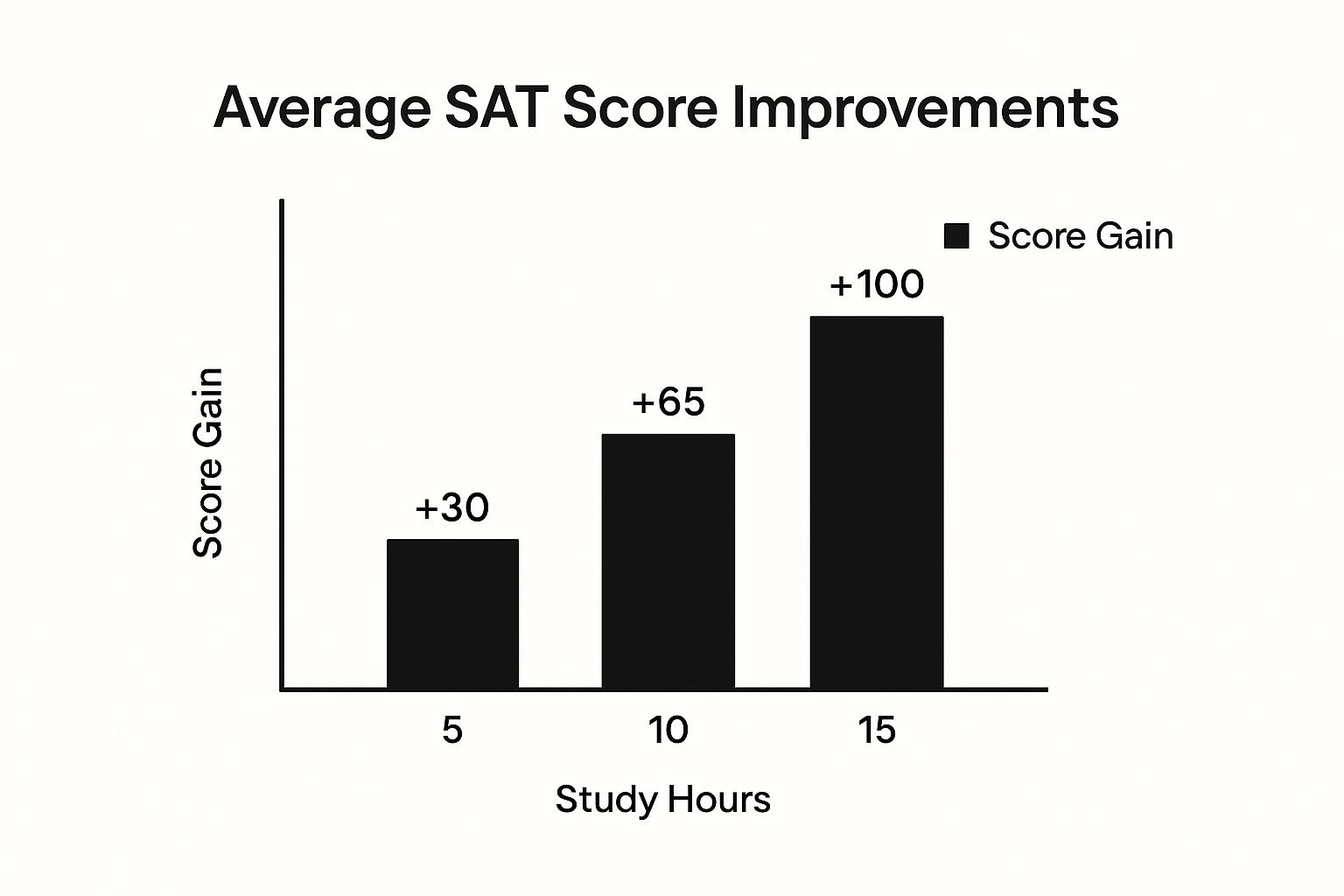
The data doesn't lie. While even a few hours help, a more serious commitment of 10-15 hours per week can lead to some significant jumps in your score.
Mental Health Resources for Teens
Finally, and this is non-negotiable, you have to prioritize mental well-being. High-stakes tests can really take a toll on a teenager's mental health. Recognizing the signs of stress and anxiety is a critical skill for both students and parents.
Here are a few resources that can make a real difference:
- The Jed Foundation (JED): This organization offers incredible resources and support for protecting the emotional health of teens and young adults.
- Mindfulness Apps: Tools like Calm or Headspace are perfect for managing test anxiety. They offer guided meditations and breathing exercises that you can do anywhere.
- School Counselors: These folks are trained to help students manage academic pressure. They can provide excellent strategies or even refer you to more specialized help if needed.
Remember to encourage a balanced life. Getting enough sleep, eating well, and making time for friends is just as important as any study schedule. A healthy mind is a prepared mind.
Mastering the Content for Each SAT Section

A great SAT score isn't just about clever test-taking tricks; it's built on a rock-solid understanding of the actual material. Real progress happens when you move past generic advice and dive deep into the specific content of the Math and Reading and Writing sections. This is how you turn weak spots into strengths and make every minute count.
The goal isn't to re-learn four years of high school. It’s about pinpointing the exact skills the SAT tests and focusing your energy there. Think of a diagnostic test as your best friend—it acts like a map, showing you exactly where your knowledge gaps are so you can study smarter, not just harder.
Unpacking the Math Section
The SAT Math section can feel intimidating, but it really just tests a core set of concepts over and over. You don't need to be a math genius, but you do need to become fluent in the language of the test. The questions fall into four main buckets.
- Algebra: This is the heavyweight. You'll need a firm grasp of linear equations, inequalities, and systems of equations. It’s the foundation for much of the section.
- Advanced Math: This is where things get a bit more complex with quadratic equations, exponential functions, and other nonlinear expressions.
- Problem-Solving and Data Analysis: Think real-world scenarios. This tests your ability to read charts and graphs, understand ratios, percentages, and work with basic stats.
- Geometry and Trigonometry: This covers the essentials like area, volume, lines, angles, and basic trigonometric functions (SOHCAHTOA is your friend).
Once a diagnostic test reveals your weaker areas, you know exactly where to focus. If you consistently miss questions on systems of equations, for example, dedicate a few study sessions solely to those problems until you can solve them quickly and confidently.
Tackling Reading and Writing
The Reading and Writing section is less about memorizing facts and more about sharpening specific analytical skills. Success here comes from knowing how to dissect passages and figure out what a question is really asking.
It boils down to a few key skills:
- Reading Comprehension: This is about finding the main idea, understanding the author's tone, and making logical inferences from the text provided.
- Command of Evidence: These questions are a two-parter. They ask you to identify the specific lines in a passage that best support your answer to the previous question. It’s all about connecting claims to textual proof.
- Grammar and Punctuation: You need to know the essential rules of standard English—subject-verb agreement, pronoun usage, comma rules, and the like. It's not about obscure rules, but the ones we use every day.
Data from the College Board backs this up. Their research shows that score improvements are directly linked to strengthening reading comprehension and data analysis skills. For instance, in 2024, the average score was 519 in Evidence-Based Reading and Writing and 505 in Math, highlighting where targeted practice can make the biggest difference.
Focus on the process, not just the answer. For a tough math problem, don't just check if you got it right. Instead, walk through each step. Was your method efficient? Could a different approach have been faster? That's where the real learning happens.
The Parental Role in Content Review
Parents, your role here is to be a resource manager and a source of encouragement, not a content expert. You don’t need to know how to solve quadratic equations yourself. Your job is to help your teen find the tools and support they need to succeed.
Here’s how you can help:
- Provide Resources: Help them get high-quality study materials like official practice guides. If they're truly stuck on a subject, connecting them with a tutor can be a game-changer.
- Create a Conducive Study Space: Make sure they have a quiet, organized place to work, free from the usual household distractions.
- Encourage Breaks: Burnout is the enemy of progress. Remind them that taking breaks to recharge is a productive part of studying, not a waste of time.
Your support can help keep this whole process from feeling overwhelming, allowing your teen to focus on mastering the material without any added stress.
Developing Your Strategic Test-Taking Skills
Knowing the material is a huge win, but it’s only half the battle. Your performance on test day comes down to strategy. This is where you learn to think like the test-makers and turn all that hard-earned knowledge into points on the board.
It’s about moving beyond just checking your score on a practice test. You need to learn how to use those tests as powerful diagnostic tools—like a check-up with a doctor—to pinpoint exactly where you need to focus your efforts. The key is to build a system for reviewing every single practice test, digging into your mistakes to understand why you made them. By creating a detailed "error log," you create a feedback loop that makes every study session more effective than the last.
Use Practice Tests as Diagnostic Tools
After each practice test, don't just glance at the score and move on. That's a missed opportunity. Instead, create an error log—a simple spreadsheet or even a dedicated notebook works great. This is where you'll track every single question you got wrong.
For each mistake, you need to document a few key things:
- Question & Topic: What was the question? Be specific. (e.g., "Math – Module 1, Q12 – Systems of Equations").
- The Root Cause: Why did you miss it? Be brutally honest with yourself here.
- The Fix: What specific action will you take to avoid this mistake next time?
This process transforms frustrating mistakes from something to be discouraged by into valuable data points you can actually use to get better.
Categorize Your Mistakes
Once you start logging your errors, you'll see patterns emerge. Most mistakes fall into one of three buckets. Figuring out which type you’re making most often tells you exactly where to focus your energy.
| Error Type | What It Means | How to Fix It |
|---|---|---|
| Content Gap | You just didn't know the material. | This is a knowledge problem. Simple fix: go back to your study materials and drill down on that specific concept until you’ve got it. |
| Careless Mistake | You knew the stuff but made a silly error. | These are usually caused by rushing or mental fatigue. The solution is to practice slowing down, double-checking your work, and maybe even some mindfulness to stay focused. |
| Misread Question | You knew the content but misinterpreted what the question was asking. | This is a reading comprehension issue. Practice underlining key phrases and rephrasing the question in your own words before you even look at the answers. |
If your error log is packed with "Content Gaps," you know you need more content review. If it's mostly "Careless Mistakes," it’s time to work on focus and pacing.
Time Management for the Digital SAT
The adaptive nature of the digital SAT really changes the time management game. Since the test is broken into modules, your goal is to manage your time effectively within each one. The worst thing you can do is let one tough question derail you and eat up precious minutes.
A smart test-taker knows when to cut their losses. If a question has you stumped, make an educated guess, flag it for review, and move on. You can always come back later if there’s time. The goal is to answer as many questions correctly as you can, not to get every single one right.
And remember, an educated guess is always better than leaving an answer blank. Use the process of elimination to cross out choices you know are wrong. This simple trick can dramatically improve your odds.
The Value of School-Day Testing
One of the best, low-stress ways to get a real test under your belt is to take advantage of school-day testing programs. These opportunities are a game-changer because they remove common hurdles like getting to a test center or giving up a weekend. The test is often free and offered in a familiar environment.
The numbers show just how valuable these programs are. In the 2023-24 school year, over 1.35 million students participated—that’s a whopping 68% of all SAT takers in the class of 2024. This record-breaking rate proves how much these programs help provide fair access to the test. You can find more insights on SAT School Day trends and their benefits from EdisonOS.
A Parent's Guide to Test Strategy
Parents, your job here is to be the voice of calm and reason. Your teen is probably feeling a ton of pressure to hit a certain score on their practice tests. Your role is to help them see these practice runs as learning opportunities, not final judgments.
Here’s how you can help:
- Reframe "Failure": Help them see that every mistake made in practice is a chance to get stronger for the real thing. It's a good thing, not a bad one.
- Focus on the Process: Instead of asking, "What was your score?", ask, "What did you learn from your error log this week?" Praise their effort and consistency, not just the outcome.
- Manage the Environment: Help them simulate real test conditions for practice—a quiet room, timed sections, no interruptions. This makes the actual test day feel familiar and routine, which is a huge anxiety-reducer.
Your support can help shift your teen’s mindset from a fear of making mistakes to an appreciation for the growth that comes from them.
Overcoming Procrastination and Building Motivation

Here's a hard truth: you can have the best test-taking strategies in the world, but they mean nothing if you can't get yourself to sit down and actually study. For so many students, the mental game of SAT prep is the biggest hurdle.
Let’s get one thing straight. Procrastination isn't about laziness. It's an emotional response, usually to feeling overwhelmed by a massive, high-stakes goal. Your brain is trying to protect you from the anxiety of it all.
The way out is to dismantle that anxiety. When you feel the pull to put off studying, it’s often because the task—"study for the SAT"—feels huge and undefined. The secret is to break it down into tiny, manageable pieces that don't trigger that "fight or flight" response.
Break Down Your Goals to Beat Procrastination
Instead of a vague goal like "study Math," get super specific. Try something like, "Complete 10 Algebra practice problems from Chapter 3." See the difference? That's a small, concrete task you can actually start—and finish.
Completing it gives you a quick win and a hit of dopamine, building the confidence and momentum you need to tackle the next small thing.
One of the most powerful tools I've seen for this is the Pomodoro Method. It’s incredibly simple but works wonders for building study endurance.
- Pick one specific task. Let’s say, "Review 5 vocabulary words."
- Set a timer for 25 minutes. For those 25 minutes, you do only that one task. No phone, no other tabs, no distractions.
- Take a 5-minute break. When the timer goes off, you must step away. Get some water, stretch, or listen to a song.
- Repeat the cycle. After four "pomodoros" (that’s what the 25-minute work sessions are called), you earn a longer break of 15-30 minutes.
This technique trains your brain to focus in short, intense bursts, which makes longer study sessions feel way less intimidating. It's a practical way to learn how to stop procrastinating by turning a mountain of work into a series of small, easily climbable hills.
Find Your "Why" to Fuel Motivation
Discipline alone won't get you through months of prep. Real, long-term motivation comes from connecting your SAT grind to your bigger life goals.
So, why are you doing this? Is it to get into your dream college? Earn a scholarship that makes a real difference? Open the door to a career you're passionate about?
Take a few minutes and actually visualize your future. Picture yourself walking across your dream campus or succeeding in your chosen field. Write these goals down and stick them somewhere you'll see them every day. When your motivation dips—and it will—revisiting your "why" is the spark that will get you back on track.
Your SAT score is not a measure of your worth. It's a tool—a key to help you unlock the future you want. Connecting your daily study efforts to that future vision is the most powerful source of motivation you have.
A Parent's Guide to Fostering Motivation
Parents, your role here is crucial, but it's a delicate one. Nagging or adding pressure almost always backfires. It creates resistance and can make procrastination even worse. Think of yourself as a supportive coach, not a drill sergeant.
It's also vital to tell the difference between procrastination and genuine burnout. Procrastination is often about avoiding an anxious task. Burnout is deep emotional and physical exhaustion. If your teen is constantly irritable, exhausted, and losing interest in things they used to love, they might be burned out. The answer to burnout is rest, not more pressure.
Here are a few positive ways you can help your teen build sustainable habits:
- Focus on the Process, Not Just the Results. Praise their effort and consistency. "I saw you used the Pomodoro timer today, that's awesome!" means so much more than "How did you score?" This builds a growth mindset.
- Help Them Create a Reward System. Work together to set up small, meaningful rewards for hitting their study goals. This could be anything from their favorite takeout after a solid week of studying to a movie night.
- Just Listen. Create a safe space where they can vent about their fears and frustrations without you immediately jumping in to "fix" it. Sometimes, the most helpful thing you can do is just listen and validate their feelings.
When you foster a sense of ownership, you empower your teen to take control of their own SAT journey. It stops being a stressful chore and becomes a personal challenge they are genuinely motivated to conquer.
Don’t Let Test Day Anxiety Sabotage Your Score
All the practice problems and study guides in the world won’t help if your mind isn’t in the right place on test day. I’ve seen it happen time and again: a smart, well-prepared student freezes up because the pressure gets to them. Knowing how to improve SAT scores is as much about managing your head as it is about mastering the content.
Think of your well-being as a core part of your prep strategy, not some optional add-on. Trying to power through stress is like running a race with a heavy backpack—it just slows you down and burns you out. Research has shown that high anxiety can mess with your working memory and problem-solving skills, which are the exact tools you need to crush the SAT. So, let's make mental health a priority.
Build Your Mental Toolkit
Just like you drill math formulas, you need to practice techniques to calm your mind. These aren't complicated, but they are incredibly powerful tools you can pull out anywhere, anytime.
- Mindful Breathing: When you feel that wave of panic starting to build, just focus on your breath. The "box breathing" technique is a lifesaver. Inhale for four seconds, hold for four, exhale for four, and hold again for four. A few cycles of this can ground you in the present moment almost instantly.
- Simple Visualization: Before the test, take a few minutes to close your eyes. Picture yourself sitting at the desk, feeling confident and calm. See yourself breezing through the problems and feeling that sense of accomplishment. This kind of mental rehearsal can make the real thing feel way less intimidating.
- Grounding Exercises: If your mind starts racing during a practice test (or the actual exam), try the 5-4-3-2-1 method. Silently name five things you see, four things you can feel, three things you hear, two things you smell, and one thing you can taste. It pulls your focus away from the anxiety and back to your surroundings.
If you want to dig deeper, we have a whole guide on this. You can learn more about how to reduce test anxiety with our detailed guide, which is packed with more practical techniques.
A Balanced Life is Your Secret Weapon
Your brain is an organ, and it needs proper care to perform at its peak. Those all-night cram sessions fueled by junk food? They’re actually working against you. A balanced lifestyle is one of the most effective tools for supporting your mental health and cognitive game.
This starts with sleep. You need to be getting 8-10 hours a night, period. Sleep is when your brain actually consolidates memories and locks in what you’ve learned. Good food matters, too—nutrient-rich meals fuel your brain, while exercise is a proven stress-buster that sharpens your focus. And please, don't isolate yourself. Make time for friends and hobbies. Those things aren't distractions; they’re essential for recharging your mental batteries.
Test anxiety is a totally normal response to a high-pressure situation. The goal isn't to get rid of it, but to manage it so it doesn't control you. Learn to see it as nervous energy you can channel into focus, not fear.
Where to Find Credible Support
You are not in this alone. There are fantastic organizations out there dedicated to supporting students’ emotional well-being. Knowing where to turn for solid information is a sign of strength.
The Jed Foundation (JED) is an excellent resource focused specifically on protecting the emotional health of teens and young adults.
This screenshot from The Jed Foundation's website shows how they make it easy to find help. Their site has everything from info on common struggles to direct support for anyone in crisis, making it a great place for both students and parents to start.
A Parent's Role in All This
Parents, your support here is everything. The most powerful thing you can do is create a home where it’s okay for your teen to be stressed, frustrated, or anxious without feeling judged. Your job is to be a listener and a source of calm reassurance.
Encourage them to take breaks, model healthy ways of coping with stress yourself, and keep the lines of communication wide open. Remind them that an SAT score doesn't define who they are or what their future holds. By fostering a supportive and balanced environment, you're helping them build the resilience they need to face this challenge—and any others that come their way.
Answering Your Top SAT Improvement Questions

As you get deeper into your SAT prep, you're bound to hit some roadblocks and have questions. It’s completely normal. This is the part of the journey where the what-ifs and uncertainties start to creep in.
I want to tackle some of the most common questions I hear from students and parents. My goal is to give you straight, honest answers that cut through the noise and help you build a prep plan that actually works for you.
How Many Hours a Week Should I Study for the SAT?
There's no magic number here, and the first thing to remember is that quality crushes quantity every time. Just clocking hours won't guarantee a better score.
I've seen students succeed with a wide range, but a good starting point is 5-10 hours of focused study per week. Where you land in that range depends on three things: your starting score, your goal score, and how much time you have until test day. Someone trying to jump 200 points in two months needs a more intense schedule than someone aiming for a 50-point bump over six months.
Let your diagnostic test be your guide. If you're solid on the Reading section but Algebra is tripping you up, pour your energy there. Don't waste time on what you already know.
Are Expensive SAT Tutors or Courses Worth It?
This is a big one, and it's a conversation a lot of families have. Paid prep can be a game-changer for students who need that extra structure and accountability. There’s real value in having an expert guide you.
But let's be clear: they are not the only way to get a great score.
Don't overlook the incredible free resources out there. The College Board's official partnership with Khan Academy offers personalized practice that is genuinely world-class, and it costs nothing. I know plenty of students who have made huge score jumps using only these official tools.
The right choice boils down to your learning style and your family's budget. Before you drop a lot of money on a course, commit to a month of disciplined self-study with the free stuff. Track your progress. If you're improving and staying motivated, you might have your answer right there.
What Should I Do If My Score Plateaus?
Hitting a wall with your score is one of the most frustrating parts of the process. It's also incredibly common. A plateau isn't a sign that you've maxed out your potential; it’s a signal that your current strategy needs a shake-up.
When you feel stuck, it’s time to get smarter, not just work harder.
- Step Away for a Few Days: Seriously. Burnout is real, and it leads to sloppy mistakes and a total lack of focus. Taking a short break can help you come back with fresh eyes.
- Go Deep on Your Error Log: A plateau often means you're making the same subtle mistakes over and over. Go back through your practice tests and look for patterns. Is it a specific type of geometry problem? Questions that use the phrase "most nearly means"? Finding these weak spots is the key to breaking through.
- Switch Your Focus: If you've been hammering away at Math for weeks, pivot to Reading and Writing. Give one part of your brain a rest while you fire up another. You'd be surprised how often this leads to an unexpected breakthrough.
A Parent's Guide to Supporting Through Tough Questions
Parents, your role here is to be the steady hand, the voice of reason. You can help your teen navigate these decisions without piling on more pressure.
- On Study Hours: Instead of asking, "Did you study for two hours?" try asking, "What was your goal today, and how did it feel?" This shifts the focus from logging time to making real, productive progress.
- On Tutors: Have an honest conversation about the family budget and what kind of support your teen actually wants. Make it a team decision, exploring everything from free resources to one-on-one coaching.
- On Plateaus: Remind them that getting stuck is a normal part of any meaningful challenge. It's not a reflection of their intelligence. Reassure them, and then help them brainstorm a new angle of attack, like taking a practice test at the library instead of at home.
Your calm confidence is one of the most powerful tools you can offer. It will help them manage their own motivation and push through the hurdles they'll inevitably face.
If your teen is struggling with procrastination, test anxiety, or a lack of direction, personalized coaching can make all the difference. At Andrew Petrillo Life Coaching, we provide practical, one-on-one support to help students build the skills and confidence they need to succeed in school and in life. Learn how we can help by visiting https://andrewpetrillolifecoaching.com.