

Problem-solving isn't just about acing a math test. It's about life. It’s the skill that helps a teen navigate everything from a fight with a friend and a soul-crushing bad grade to figuring out what they want to do after high school.
The truth is, learning how to solve problems is a process. It’s about seeing the real issue, not just the surface-level drama. From there, it’s about brainstorming a few ways out, picking one, and actually learning something from how it all shakes out. This guide is all about breaking that down with real-world advice for teens and the parents trying to support them.
Why Problem-Solving Is a Teen Superpower

Life rarely gives you a study guide or a multiple-choice quiz. Most of the time, it just throws messy, complicated situations your way and expects you to figure it out. For a teenager, learning how to develop problem solving skills is like getting a superpower. It builds the kind of real-deal confidence and independence that matters in every part of life.
This skill is absolutely essential, but it's also a place where a lot of us fall short. A revealing 2012 OECD survey found the U.S. ranked dead last among 18 developed nations in practical problem-solving. It gets worse: around 80% of unemployed Americans in that study couldn’t even catch basic errors in a simple data task. That's a massive gap. You can dig into the full findings on YaleGlobal Online, and it’s a real eye-opener.
The Four Pillars of Teen Problem Solving
To really get what we're talking about, it helps to see what these skills look like in action. Here's a quick look at the core abilities that form the foundation for effective problem-solving in everyday life.
| Pillar | What It Looks Like for a Teen |
|---|---|
| Identifying the Real Issue | Instead of just saying "I hate my job," they dig deeper to find out why—is it the boring tasks, the mean boss, or the weird hours? |
| Brainstorming Solutions | They come up with a few different options for a tough situation, not just the first one that pops into their head. |
| Taking Action | They don't just complain about the problem; they pick a solution and actually try it, even if it feels a little scary. |
| Learning and Adapting | If their first attempt to solve a friendship issue doesn't work, they reflect on what went wrong and try a new approach. |
These aren't just one-off actions; they're habits. When teens build these four pillars, they’re not just solving one problem—they’re building a framework for handling whatever life throws at them next.
Bridging the Gap Between School and Life
School teaches you to find the right answer. Life, on the other hand, often has a bunch of "right" answers—or sometimes, none at all. The real test isn't what you know; it's what you do when you have no idea what to do. That's where problem-solving shines.
It’s the engine behind so much more:
- Motivation and School Performance: A teen with these skills doesn't just stare at a hard assignment and give up. They'll try a different tactic, ask a teacher for help, or break it into smaller pieces. A lack of motivation or a tendency to procrastinate often stems from feeling overwhelmed, and problem-solving provides the tools to dismantle that feeling.
- Mental Health and Resilience: Social drama or a wave of anxiety feels a lot less crushing when you can frame it as a problem to be solved, not a permanent roadblock. It's about agency.
- Future Success: Ask any employer. Problem-solving is consistently one of the top soft skills they're desperate to find. The ability to look at a mess and create a strategy is pure gold in any career.
A huge parenting tip here is to shift from being the "fixer" to being the "coach." When your teen comes to you with a problem, fight that powerful urge to just solve it for them. Instead, ask a question like, "What have you thought about trying so far?" It’s a simple change, but it empowers them to start building their own problem-solving muscles.
Ultimately, this is all about preparing teens for a world that's anything but predictable. It’s about teaching them to face the unknown not with fear, but with curiosity and a game plan. When we focus on the process of figuring things out instead of just the final grade, we help them build the resourcefulness they'll need for the rest of their lives.
Building a Resilient Problem-Solving Mindset
Before you can solve a problem, you have to believe you can. That's the whole game. Developing real problem-solving skills starts with building a resilient mindset—it's the engine that powers you through challenges instead of letting them stop you dead in your tracks.
It’s all about learning to shift that inner voice from, "This is impossible," to "Okay, what's my first move?" This doesn't happen overnight. You build it piece by piece by staying curious, learning to see failure as valuable feedback, and getting comfortable with not having all the answers right away. True confidence isn't about knowing everything; it's about trusting that you have the strength to try, fail, and get back up again.
From Fixed to Growth: The Parent's Role
Parents play a massive role here. Your words and reactions can either reinforce a teen’s sense of helplessness or foster a spirit of resilience. The goal is to nurture a growth mindset—the belief that abilities aren’t fixed, but can be developed through dedication and hard work.
- Praise the Process, Not Just the Outcome: Instead of, "You got an A, you're so smart!" try something like, "I saw how hard you worked on that project. Your strategies really paid off." This connects success to effort, which is something a teen can actually control.
- Model Healthy Problem-Solving Out Loud: When you hit a snag, talk through it. "Ugh, the car won't start. Okay, first, I'll check the battery. If that's not it, I'll look up a local mechanic." This simple act shows that problems are a normal part of life and that there's a process for handling them.
- Create a Safe Space for Failure: Let your teen know it's okay if things don't work out. Frame mistakes as learning opportunities. Asking, "What did you learn from that?" is way more powerful than, "Why did you mess that up?"
A key shift for parents is to act as a coach, not a controller. When your teen is stuck, fight the urge to jump in and solve it for them. Ask open-ended questions like, "What are your options here?" or "What's one small thing you could do to move forward?" This builds their problem-solving muscle and shows you trust them to figure things out.
Conquering Procrastination and School Stress
Procrastination and school performance are deeply tied to a teen's problem-solving mindset. Let's be honest: procrastination usually isn't about laziness. It's a coping mechanism for feeling overwhelmed, anxious, or terrified of failure. When a huge project feels like an unconquerable mountain, putting it off feels safer than trying and failing. Lacking motivation for schoolwork often links back to not knowing how to start.
Breaking this cycle is everything. Encourage your teen to see a big assignment not as one giant problem, but as a series of smaller, manageable tasks. This approach is all about building effective habits. For teens who struggle to even get started, our guide on goal setting for teenagers offers practical strategies to turn those big ambitions into actionable steps.
Finding Support for Teen Mental Health
Sometimes, the barriers to problem-solving are rooted in deeper mental health challenges. Persistent anxiety, depression, or overwhelming stress can make even small problems feel impossible. It's vital for both teens and parents to recognize when it's time to call in professional support, especially when issues like procrastination and low motivation become chronic.
Here are a few trusted resources that can help:
- The Jed Foundation (JED): This organization is focused on protecting the emotional health of teens and young adults and preventing suicide. Their website has excellent resources for both teens and parents on topics ranging from anxiety to preparing for college.
- The Trevor Project: A fantastic resource offering crisis intervention and suicide prevention for LGBTQ young people under 25. They have a 24/7 hotline, text, and chat service.
- Psychology Today's Therapist Finder: This is a practical tool for finding licensed therapists and counselors in your area. You can filter for specialists in teen issues, anxiety, and more.
- The Child Mind Institute: Offers in-depth, research-backed information on a wide range of teen mental health and learning disorders, along with practical parenting advice.
Recognizing you need help and reaching out for it isn't a sign of weakness. In fact, it's one of the most powerful problem-solving moves you can make. It’s about identifying the real issue and taking a concrete step toward a solution.
A Practical Framework for Navigating Any Challenge
Having a resilient mindset is the foundation, but what do you do when you’re actually in the middle of a problem? This is where a practical framework comes in. Forget rigid, step-by-step rules. Think of this as a flexible mental toolkit you can adapt to any challenge, from a looming project deadline to a conflict with a close friend.
This process gives you structure when your thoughts feel chaotic. It’s all about moving from that overwhelmed, stuck feeling to a place of empowerment and control. The goal isn't to find a "perfect" solution but to build a reliable process for making thoughtful decisions and taking meaningful action.
This visualization shows how teams often gather to brainstorm ideas—a critical stage in solving complex problems.
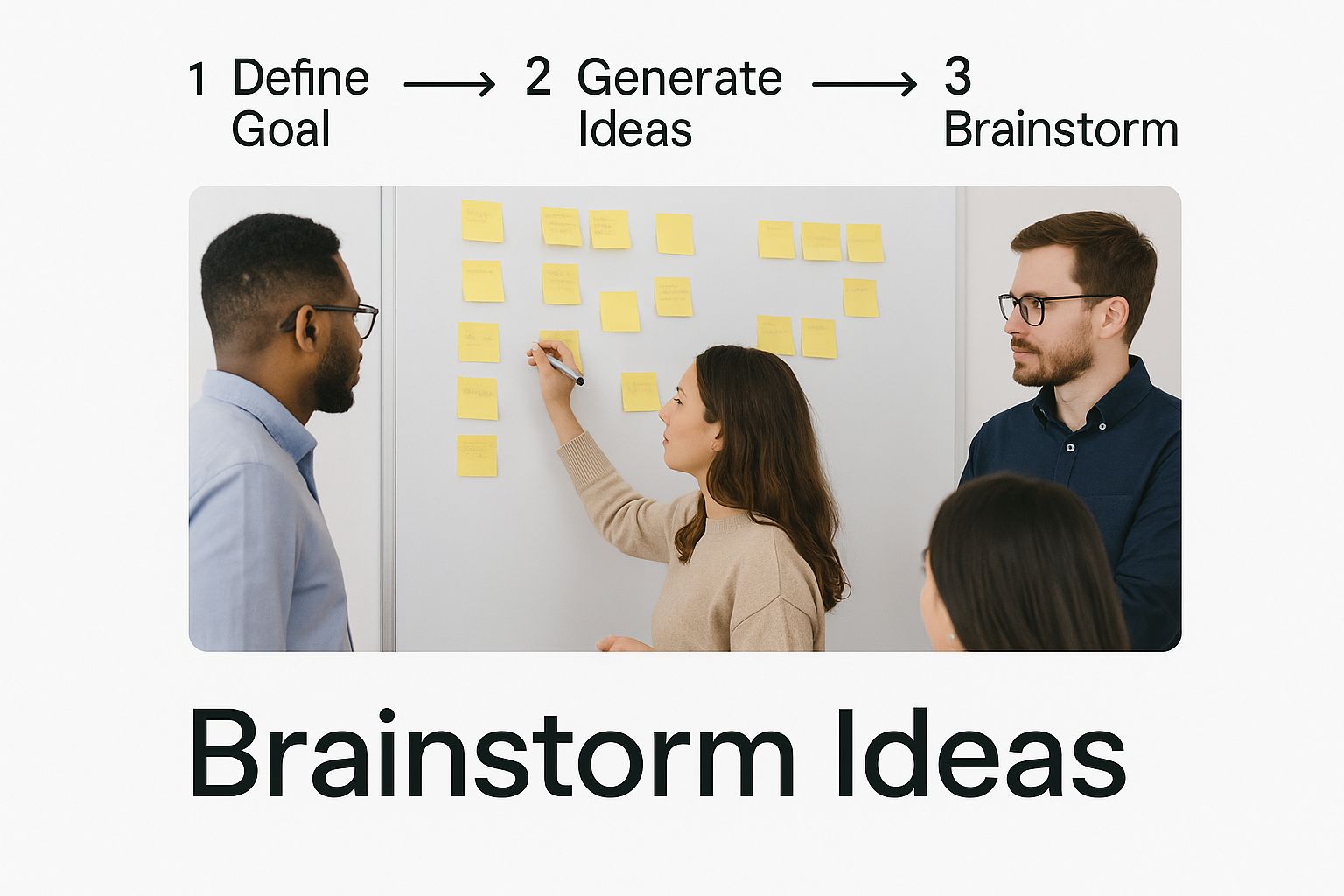
As the image highlights, collaboration and generating a ton of options are key before you ever settle on a single path forward.
Stage 1: Define the Real Problem
You can't solve a problem you don't understand. The first and most crucial step is to define what’s really going on, not just the symptoms you see on the surface. So often, what feels like the problem is just a surface-level frustration.
A teen might say, "I'm failing my history class." That’s a symptom. The real problem could be something deeper:
- Procrastination: They wait until the last minute to study, which tanks their test performance.
- Lack of Understanding: They don’t grasp the core concepts and are afraid to ask for help.
- Time Management: They're overwhelmed with sports, a part-time job, and other classes, so history gets pushed aside.
Parenting Tip: When your teen presents a problem, resist the urge to jump straight to solutions. Instead, ask questions to help them dig deeper. "What makes you say you're failing?" or "What part of the class feels the most difficult?" can help them pinpoint the root cause on their own.
Getting this stage right is everything. Trying to solve "I'm failing history" might lead to hiring a tutor. But if the real issue is procrastination fueled by anxiety, a tutor won't fix the underlying issue.
Stage 2: Brainstorm Creative Solutions
Once you have a clear definition of the problem, it’s time to get creative. The goal here is to generate as many potential solutions as you can think of. Don't filter or judge any ideas just yet. Let them flow.
Let’s stick with the history class example. If the real problem is procrastination because they feel overwhelmed, some brainstormed ideas might look like this:
- Break down studying into 20-minute chunks.
- Form a study group with a friend.
- Talk to the teacher about the upcoming test.
- Schedule specific study blocks in a planner.
- Delete social media apps from the phone during study hours.
- Ask parents for help creating a weekly schedule.
This process is all about opening up possibilities. Not every idea will be a winner, and that’s totally okay. You just want to avoid getting stuck on a single, obvious solution and instead explore a whole range of creative options.
Stage 3: Evaluate and Create an Action Plan
Now it's time to put on your critic hat. Go through your list of brainstormed solutions and start evaluating them. Which ones are the most realistic? Which ones are most likely to actually make a positive impact?
This is where you move from scattered ideas to a concrete plan. For each promising solution, it helps to think through the pros and cons.
| Potential Solution | Pros | Cons |
|---|---|---|
| Form a study group | Makes studying more engaging; can clarify confusing topics. | Could be distracting if the friend isn't focused. |
| Delete social media apps | Removes a major source of procrastination. | Might feel isolating or be difficult to stick with. |
| Talk to the teacher | Shows initiative; teacher may offer extra help or advice. | Can feel intimidating or embarrassing. |
After weighing the options, the teen can build a simple, clear action plan. It might look something like this: "This week, I will ask my friend Maya to study with me on Tuesday. I will also talk to Mr. Harris after class on Wednesday to ask about the test." This turns vague ideas into specific, actionable steps.
Stage 4: Implement and Reflect
A plan is useless until you act on it. This final stage is about putting your plan into motion and—just as importantly—reflecting on what happened. This is a critical step in how to develop problem solving skills because it’s where the real learning happens.
Did the study group help? Did talking to the teacher make a difference? If something worked, fantastic. If it didn't, it's not a failure—it's just data. That information helps you adjust your approach for next time. Maybe the study group was too distracting, so next time you’ll try studying alone in the library.
This adaptive skill is a global challenge. The 2012 Programme for International Student Assessment (PISA) found that only about 11% of 15-year-olds in developed countries were top performers in problem solving, able to create multi-step solutions and adjust their plans on the fly. You can read more about these student problem-solving skill findings on OECD.org. Developing this ability is a huge advantage.
This four-stage framework—Define, Brainstorm, Plan, Implement—isn't a rigid formula. It's a mental habit that builds confidence, reduces anxiety, and empowers teens to face any challenge with a clear head and a sense of purpose.
Tackling Procrastination Anxiety and Other Roadblocks
It’s one thing to have a great problem-solving framework. It’s another thing entirely to actually use it when your brain is screaming at you to do literally anything else.
Often, the biggest roadblocks to solving problems aren't a lack of ideas—they're the mental hurdles that stop us before we even start. Procrastination, anxiety, and a lack of motivation are all deeply connected, and they can be paralyzing, especially when it comes to school.
Let's get real about why teens and young adults put things off. It's almost never about being "lazy." Instead, it’s an emotional response to feeling completely overwhelmed, fearing failure, or wrestling with perfectionism. When a task feels huge and impossible, putting it off gives a moment of relief from that stress. Learning how to develop problem solving skills means we first have to learn how to manage these very real emotional barriers.
The Real Reasons We Procrastinate
Procrastination is usually a symptom of something deeper. If you can get to the root cause, you can start to untangle it. For many teens, school is the main arena where these feelings show up.
Here are some of the most common culprits I see:
- Anxiety and Overwhelm: A massive research paper or a final exam can feel like an unclimbable mountain. The sheer size of the task triggers anxiety, making it feel safer to just avoid it.
- Perfectionism: The fear of not doing something perfectly can be paralyzing. A teen might think, "If I can't do this flawlessly, I'm not doing it at all." This all-or-nothing mindset turns every assignment into a high-stakes performance.
- Low Motivation: If a teen doesn't see the point of an assignment or feels totally disconnected from the material, mustering up the motivation to even begin can feel impossible.
These things create a nasty cycle. You feel anxious about a task, so you put it off. That procrastination then creates more anxiety as deadlines get closer, which makes it even harder to start.
Parenting Tip: When you see your teen procrastinating, try approaching it with curiosity instead of criticism. Ask something like, "This project seems like it's really weighing on you. What's the hardest part about getting started?" This opens the door to understanding the real issue, whether it’s anxiety, confusion, or something else entirely.
Actionable Strategies to Fight Back
Breaking the procrastination cycle isn't about finding some magical burst of motivation. It’s about using small, practical strategies to make starting feel less daunting. The goal is to make the first step so small it feels almost effortless.
Here are a few techniques that actually work:
- The 5-Minute Rule: Commit to working on that dreaded task for just five minutes. That's it. Anyone can do something for five minutes. Often, the hardest part is just starting, and once you get over that initial hump, continuing for another five feels much more manageable.
- Task Chunking: Break down a big, intimidating project into tiny, specific micro-steps. "Write history paper" is overwhelming. But "Find three sources for history paper" is a concrete, doable task.
- Time Blocking: Schedule specific, non-negotiable blocks of time in a planner to work on something. When you treat it like an appointment with yourself, it adds a layer of structure and accountability.
By using these small habits, you can learn how to stop procrastinating—a crucial part of becoming a better problem-solver. Building momentum with small wins is the key to quieting that anxious voice in your head. For a deeper dive, check out my full guide on how to stop procrastinating.
Knowing When to Seek Professional Support
While these strategies are great for everyday procrastination, sometimes the issue is a symptom of a more significant mental health challenge. Persistent anxiety, depression, or ADHD can make it incredibly difficult to focus and manage tasks. It’s so important to recognize when self-help strategies aren't enough.
Asking for help is a sign of strength—a powerful problem-solving move in itself. If procrastination is causing serious distress, tanking grades, or hurting a teen's self-esteem, it's time to reach out. A school counselor, a trusted family doctor, or a licensed therapist can offer support and coping mechanisms that are tailored to their needs.
If you or your teen need support, it can be tough to know where to start. Here is a curated list of trusted organizations that offer information, support, and direct help for the mental health challenges teens face.
Mental Health Resources for Teens and Parents
| Resource Name | What It Offers | Best For |
|---|---|---|
| The Jed Foundation (JED) | Comprehensive resources, educational programs, and support for protecting teen emotional health and preventing suicide. | Parents and teens looking for educational materials and guidance on mental wellness. |
| The Trevor Project | Crisis intervention, suicide prevention, and community support services for LGBTQ young people under 25. | LGBTQ teens and young adults seeking a safe, affirming space for crisis support. |
| Psychology Today | A searchable database to find licensed therapists, psychiatrists, and treatment centers in your area. | Finding a local therapist who specializes in teen issues like anxiety, depression, or academic stress. |
| The Child Mind Institute | Provides expert, research-based information on a wide range of teen mental health topics, from ADHD to depression. | Parents seeking reliable, in-depth articles and guides on specific mental health concerns. |
Ultimately, tackling these roadblocks is a core part of the journey. By addressing the underlying emotional and mental health factors, teens can clear the path to face challenges with more confidence and resilience.
Real-World Practice to Sharpen Your Skills
Theory is great, but problem-solving is a muscle. To get stronger, you have to actually use it. And I mean really use it, not just by doing worksheets.
The best way to build this skill is to weave it into everyday life. The goal is to make it a natural, even enjoyable, part of your world. Think of it less like homework and more like a series of low-stakes challenges that build your mental toolkit for when the big stuff hits.
Gamify Your Growth
This is one of my favorite ways to practice. Strategy-based games are fantastic training grounds for problem-solving. Whether you're gathered around a table with a board game or plugged into a digital world, you’re constantly analyzing situations, planning your next moves, and—most importantly—adapting when another player completely messes up your master plan.
- Tabletop Games: Games like Settlers of Catan, Ticket to Ride, or even a classic game of chess force you to think several steps ahead and make big decisions with limited information.
- Digital Games: Look for puzzle games, resource-management simulations, or strategy titles. These games reward you for thinking critically and adapting to new challenges on the fly.
A tip for parents: The real magic happens when you connect the dots for them. Ask questions like, "What was your strategy there?" or "How did you decide to use your resources that way?" This simple conversation helps teens see that they're building valuable, real-world skills, not just playing a game.
Tackle Real-Life Projects
You can find endless opportunities to practice right in your own home. Instead of treating these as chores, reframe them as challenges to be solved.
- Plan a Weekend Trip: This is a classic. It forces you to budget, schedule, coordinate with other people, and create backup plans. What if it rains? How will you get from point A to point B? It’s a puzzle with real-world pieces.
- Create a Budget: Want that new gaming console or a specific pair of shoes? The challenge isn't just wanting it; it's figuring out how to earn and save the money. This requires breaking a big goal into small, manageable financial steps.
- Fix Something Broken: Got a wobbly chair or a bike with a flat tire? Before you jump in to help or call someone, let them spend some time trying to figure it out themselves. Researching solutions online and attempting a repair is a masterclass in practical problem-solving.
This kind of hands-on practice builds more than just skill. It builds a deep-seated sense of capability and resilience. To support this growth, our guide on building resilience in teens offers complementary strategies for parents and teens alike.
Interestingly, research shows this skill development isn't always a straight line. A 2023 study found that students' problem-solving abilities improved significantly from grade 7 to 8 but then actually declined in grade 9. This tells me that early adolescence is a critical window for building these skills before other academic or cognitive shifts get in the way. Consistent practice is everything.
Got Questions? Let's Talk.
When you're trying to help a teen build new skills, specific questions always come up. It's a journey, and bumps in the road are normal. Here are some of the most common concerns I hear from parents and teens, along with some practical advice.
How Can I Help My Teen Who Gets Frustrated and Gives Up Easily?
It’s tough to watch your kid hit a wall and just stop. The first thing I always recommend is to get on their team. Instead of pushing them to try again, just validate the feeling. Saying something simple like, "I get it. That looks incredibly frustrating," can completely change the dynamic.
From there, the goal is to shrink the problem. Don't focus on the finish line; focus on the very next step, no matter how tiny. Praise their effort for trying that one small thing, not whether it worked or not. This builds momentum and starts to chip away at that fear of failing.
It also helps a ton if you model this yourself. When you hit a snag with something—a project, a recipe, anything—talk through your own frustration out loud. Let them see that setbacks are a normal, manageable part of life, not a reason to quit.
What if Procrastination Seems Linked to Serious Anxiety?
The strategies in this guide are great for tackling the kind of everyday procrastination that comes with school stress or feeling overwhelmed. But sometimes, procrastination is a symptom of something deeper, like a serious anxiety issue. If you notice a persistent pattern of avoidance that feels more intense, it's critical to seek professional support.
When a teen is using avoidance to cope, it's a sign they need more specialized tools than a guide can offer. A good mental health professional can provide targeted therapies and coping mechanisms that make a real difference.
You can start by speaking with a school counselor for a referral, or check out trusted resources like The Jed Foundation (JED) for excellent guidance.
Remember, recognizing you need help and then actually reaching out for it is one of the most powerful problem-solving moves anyone can make. It's a sign of incredible strength and self-awareness.
If your teen is struggling with procrastination, motivation, or just figuring out their next steps, Andrew Petrillo Life Coaching can help. I offer one-on-one support to build the real-world skills they need to thrive.
Find out how personalized coaching can turn that feeling of overwhelm into confident action. Schedule a complimentary discovery call today.




1 thought on “How to Develop Problem Solving Skills: Tips for Teens & Parents”
Pingback: A Guide to Improving Critical Thinking Skills - Andrew Petrillo Life Coaching